What Is COSHH LEV Testing and Why Does Every Employer Need to Know About It?
If you are an employer in the UK, you have a legal and moral responsibility to protect the people who work for you. That responsibility extends far beyond visible hazards like wet floors or faulty machinery. It covers the invisible dangers too the dust, fumes, vapours, and gases that float through your workplace air every single day, often completely unnoticed, silently damaging the health of your workforce.
COSHH LEV testing sits right at the heart of this responsibility. Yet despite being a legal requirement for thousands of businesses across the UK, it remains one of the most misunderstood and most frequently overlooked areas of workplace health and safety compliance.
This guide will explain exactly what COSHH LEV testing is, why it matters, what the law requires of you as an employer, and what the real consequences are of getting it wrong.
What Is COSHH?
Before understanding LEV testing, it helps to understand the framework it sits within.
COSHH stands for the Control of Substances Hazardous to Health. It is a set of UK regulations first introduced in 1988 and most recently updated in 2002 that require employers to control substances that can harm the health of their workers. These substances include chemicals, dust, fumes, vapours, mists, gases, biological agents, and nanotechnology particles.
Under COSHH, employers must assess the risk posed by hazardous substances in their workplace, put control measures in place to prevent or adequately control exposure, and maintain and monitor those control measures to ensure they continue to work effectively.
The key word here is control. COSHH does not just ask you to identify hazards it requires you to actively manage them, prove they are being managed, and keep records that demonstrate ongoing compliance.
What Is LEV?
LEV stands for Local Exhaust Ventilation. It refers to any engineering system designed to capture airborne contaminants dust, fumes, vapours, mist, or gases at or near their point of generation, before those contaminants can spread into the wider workplace environment and be inhaled by workers.
LEV systems come in many forms. They include extraction hoods above welding benches, fume cupboards in laboratories, dust extraction systems in woodworking shops, on-tool extraction on grinding equipment, spray booth ventilation in automotive workshops, and general exhaust systems in chemical processing facilities.
What all LEV systems have in common is a single purpose: to protect workers from breathing in substances that could damage their health. When an LEV system is working correctly, it is often one of the most effective control measures available under COSHH. When it is not working correctly when airflow has dropped, when hoods are positioned incorrectly, when ducts are blocked or damaged it provides a false sense of security while workers continue to be exposed.
This is precisely why LEV testing exists.
What Is COSHH LEV Testing?
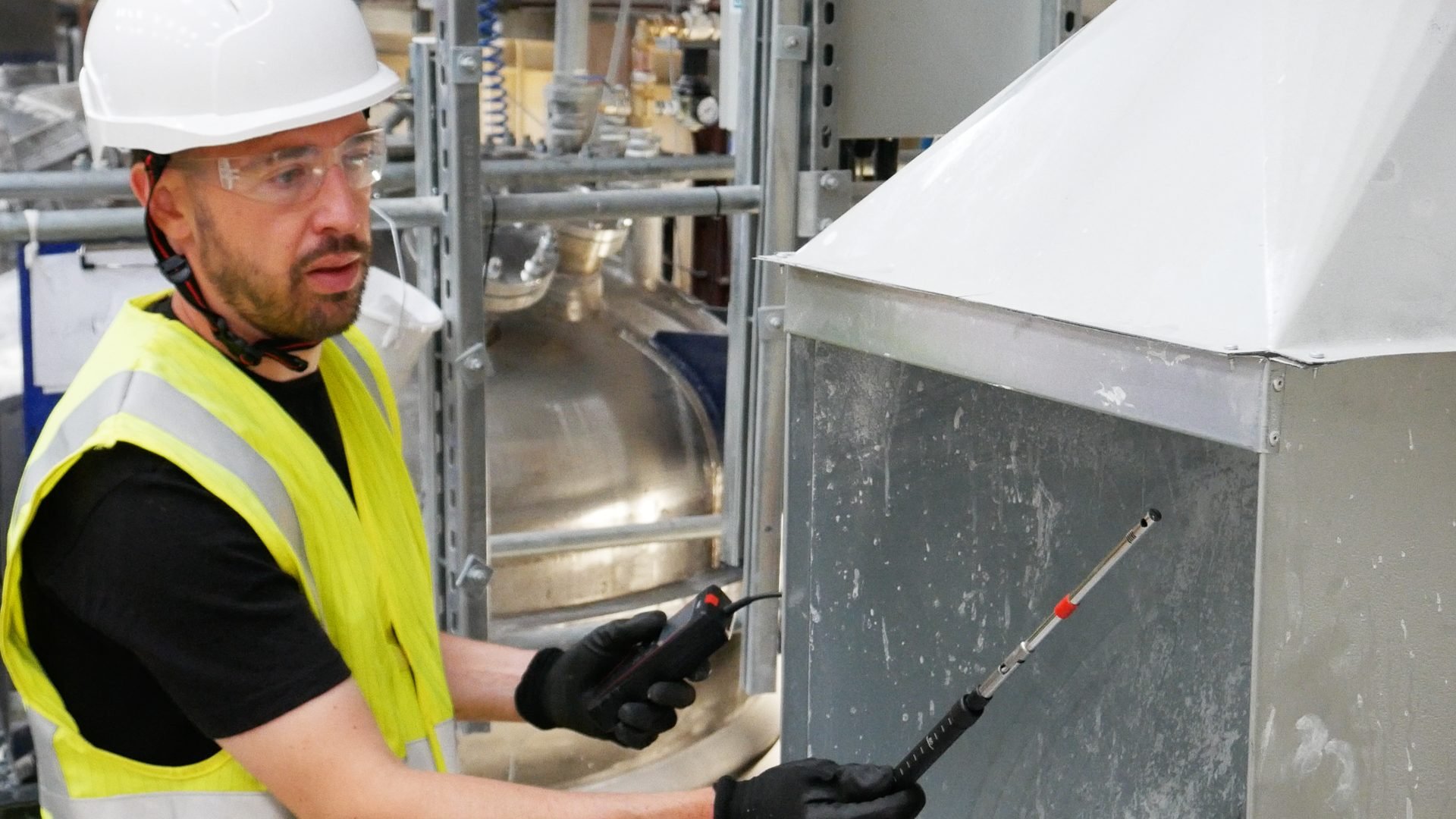
COSHH LEV testing formally known as thorough examination and testing (TExT) is the systematic inspection, measurement, and assessment of an LEV system to confirm that it is performing as intended and providing adequate control of hazardous substances.
Under Regulation 9 of the COSHH Regulations 2002, employers are legally required to ensure that LEV systems used to control exposure to hazardous substances are thoroughly examined and tested at least every 14 months. Some industries and substances have more frequent requirements for example, woodworking operations must have their LEV systems tested every 12 months under specific HSE guidance.
A thorough examination and test is carried out by a competent person typically an occupational hygienist or a specialist LEV testing engineer and must cover the following elements:
Visual inspection of all components including hoods, ducting, filters, fan units, and discharge points to identify any physical damage, blockages, wear, or deterioration.
Airflow measurements taken at the hood face and within the duct system to confirm that capture velocity and transport velocity meet the original design specification or recognised benchmark standards.
Static pressure measurements across the system to identify resistance, blockages, or fan performance issues.
Assessment of control effectiveness confirming that the system is actually capturing contaminants at the source, rather than simply moving air around.
Smoke or tracer testing in some cases, to visually demonstrate the capture and containment of contaminants at the hood.
At the end of the examination, the competent person produces a written report — commonly referred to as a P601 report that documents all findings, measurements, and any defects identified. This report must be kept by the employer for at least 5 years.
Why Is COSHH LEV Testing So Important?
1. LEV Systems Degrade Over Time
An LEV system that was working perfectly when it was installed will not continue to perform at that level indefinitely without maintenance and testing. Filters become blocked. Fan belts wear. Ducts corrode or get damaged. Hood positions get changed by workers seeking more comfortable working positions. These changes happen gradually and are rarely obvious to the untrained eye.
The result is an LEV system that appears to be working the fan is running, air is moving but is no longer providing adequate control of the hazardous substance it was installed to manage. Workers continue to be exposed. Health damage accumulates. And the employer remains entirely unaware because there is no monitoring in place.
Regular COSHH LEV testing is the only reliable way to confirm that your LEV system is actually doing its job.
2. The Health Consequences Are Severe and Often Irreversible
Occupational lung disease is the single biggest cause of work-related ill health in the UK. Conditions including occupational asthma, chronic obstructive pulmonary disease (COPD), silicosis, and occupational cancer are directly linked to workplace exposure to dusts, fumes, and chemicals that adequate LEV systems are designed to control.
What makes these conditions particularly devastating is that many of them are irreversible. Silicosis, caused by inhaling fine silica dust, causes permanent and progressive lung scarring. Occupational asthma, once developed, often persists even after the worker is removed from exposure. Mesothelioma, caused by asbestos exposure, is fatal.
These are not rare or theoretical outcomes. The HSE estimates that approximately 12,000 workers in the UK die each year from occupational lung disease. Behind each of those statistics is a workplace where hazardous substances were not adequately controlled.
3. It Is a Legal Requirement Not a Choice
COSHH LEV testing is not best practice or a recommendation. It is a legal requirement under Regulation 9 of the COSHH Regulations 2002. Failing to carry out thorough examination and testing of your LEV systems within the required timeframes is a breach of law, regardless of whether any harm has actually occurred.
The Health and Safety Executive (HSE) has the power to inspect workplaces, request LEV test records, issue improvement notices, issue prohibition notices that shut down operations, and prosecute employers. Fines for COSHH breaches can run into hundreds of thousands of pounds. In cases where worker harm has resulted from non-compliance, custodial sentences for responsible individuals are a very real possibility.
4. Your Insurance May Not Protect You Without It
Many employers assume that their employer's liability insurance provides a safety net if something goes wrong. What they do not realise is that failure to comply with statutory requirements including COSHH LEV testing can invalidate an insurance claim entirely. If a worker develops an occupational disease linked to inadequate LEV control, and your insurer discovers you were not maintaining required testing records, you may find yourself personally liable for compensation claims that can reach into the millions.
Who Needs COSHH LEV Testing?
If your workplace uses any process that generates dust, fumes, vapours, mist, or gases that could be hazardous to health, and you have an LEV system in place to control that exposure, you need COSHH LEV testing. This covers an enormous range of industries and workplaces including woodworking and joinery, metal fabrication and welding, automotive repair and spray finishing, pharmaceutical and chemical manufacturing, food processing, laboratories, dental practices, nail salons and beauty studios, printing and finishing, construction and stonework, and many more.
A common misconception is that small businesses are exempt or that COSHH LEV testing only applies to large industrial operations. This is completely false. The regulations apply equally to a two-person joinery workshop and a 500-employee manufacturing plant. The size of the business does not change the legal obligation or the health risk to workers.
What Happens If You Fail a COSHH LEV Test?
A failed LEV test does not automatically mean your operations must stop but it does mean you have a clearly documented defect in a safety-critical control measure, and you are legally obliged to address it.
Minor defects must be rectified within a specified timeframe, usually within one month. Major defects those that significantly compromise the control effectiveness of the system should be addressed immediately, and in some cases the process generating the hazardous substance should not continue until the defect is remediated.
All defects, remediation actions, and re-test results must be documented and retained as part of your COSHH records.
Final Thought
COSHH LEV testing is not a box-ticking exercise. It is the mechanism by which you confirm with evidence, with data, and with legal compliance that the control measures you have put in place are actually protecting the people in your care.
Every employer who uses an LEV system and has never commissioned a thorough examination and test is operating on assumption. They are assuming the system works. They are assuming their workers are protected. They are assuming they are compliant.
In occupational health, assumptions cost lives.
Do not wait for an HSE inspection, a worker's compensation claim, or a diagnosis of occupational lung disease to find out whether your LEV system is doing its job. Commission your COSHH LEV testing today — and know for certain.